Telerehabilitation: what it is and how to set it up.
What Italy's 2021 State-Regions Agreement says, for which patients, with which requirements and how it is paid. For facilities and clinicians.
Published on
What telerehabilitation is
Telerehabilitation is rehabilitation delivered remotely through digital tools. In Italy the reference is the State-Regions Agreement of 18 November 2021, which defines it as the remote delivery of services intended to enable, restore, improve or maintain the psychophysical functioning of people of all ages with congenital or acquired, temporary or permanent disabilities or disorders, or at risk of developing them.
It is a healthcare activity carried out by healthcare professionals. It can be multidisciplinary and, when it helps the patient, involve caregivers and family members. It is used as a continuation of, a complement to or an alternative to in-person rehabilitation, alongside other care services.
Patients receive it wherever they are: at home, in a healthcare or social care facility, at school or at work. It also covers checking remotely that aids, orthoses and prostheses are used correctly in everyday life.
Remote rehabilitation and telemedicine
Remote rehabilitation and telerehabilitation describe the same activity. Telerehabilitation is part of telemedicine: the 2021 Agreement builds on the national telemedicine guidance of the State-Regions Agreement of 17 December 2020 (Rep. Atti n. 215/CSR).
Who it is for and where it applies
Like in-person rehabilitation, telerehabilitation covers every age, from childhood to older adults. The Agreement lists these areas:
- motor and cognitive
- neuropsychological
- occupational
- communication and swallowing
- behavioural
Cardiac and pulmonary telerehabilitation is named separately: the Agreement refers it to dedicated national guidance.
What it can offer, according to the Agreement
- continuity of care all the way to the patient's home, even when travelling is difficult
- frequency and intensity of treatment closer to the needs of the patient and the family, which help adherence to care
- more efficient home rehabilitation services, able to take on more patients
- more room for monitoring, health education and self-care
How to start a telerehabilitation pathway
The steps the Agreement asks of the care team, before and during treatment.
Put it in the rehabilitation plan
Telerehabilitation services belong to the Individual Rehabilitation Project (PRI), the Individual Treatment Plan (PTI) or the Individual Care Project (PAI). The goals are set there.
Assess the patient's suitability in person
The multidisciplinary team decides case by case, always in person and with reference to the ICF. It weighs the rehabilitation need, the minimum skills to use the technology, also with a caregiver's help, and the patient's adherence to treatment.
Choose the mode and the schedule
Synchronous, asynchronous or mixed. The team sets the frequency and length of sessions and the length of the project, with defined, measurable goals.
Collect informed consent
The patient is told that the service is remote, what that implies and how their data is handled. Consent is kept in the clinical record and can be withdrawn at any time; if it is, the team revises the project.
Review the outcomes
The project includes a review of functional and care outcomes, also from the patient's point of view, for example with PROMs, and of their satisfaction.
What the facility needs
- Accreditation or authorisation
To deliver telerehabilitation funded by the Italian National Health Service (SSN), a facility must be accredited for those activities. Private practice needs a healthcare authorisation.
- Technology used by the rules
Hardware and software are used according to their intended purpose, in line with medical device and data protection rules. When they are medical devices, the facility relies on its clinical engineering service.
- Technical support
A service that can step in remotely or at home, for maintenance and to fix malfunctions.
- Staff training
Clinicians are trained to use telerehabilitation systems. The Agreement asks health authorities to include this training in their staff training plan.
- Caregivers and mediators
The team considers whether to involve a caregiver, trained to support the patient before, during and after sessions, and, when needed, a cultural and language mediator.
How telerehabilitation is paid
The Agreement states that telerehabilitation services are paid the same tariff as the same services delivered in person. How that applies depends on the care setting.
- Outpatient: the tariff of the same in-person service.
- Integrated home care (ADI): when run by the health authority, the outpatient tariff. When delivered by a contracted private provider, no extra payment for services already in the contract; for the others, terms agreed with the health authority.
- Nursing homes (RSA): if the service is already included in the daily rate, no extra payment. Otherwise it is prescribed on an SSN prescription and paid at the outpatient tariff.
- Rehabilitation centres under art. 26 of Law 833/1978: the rules of the setting in which the service is delivered.
Each Region adopts the Agreement through its own acts: codes and tariffs are found in the acts of the Region where the facility operates.
Where Selfmotion fits
Selfmotion is a telerehabilitation platform for facilities and clinicians: an app for the patient, a dashboard for the clinician.
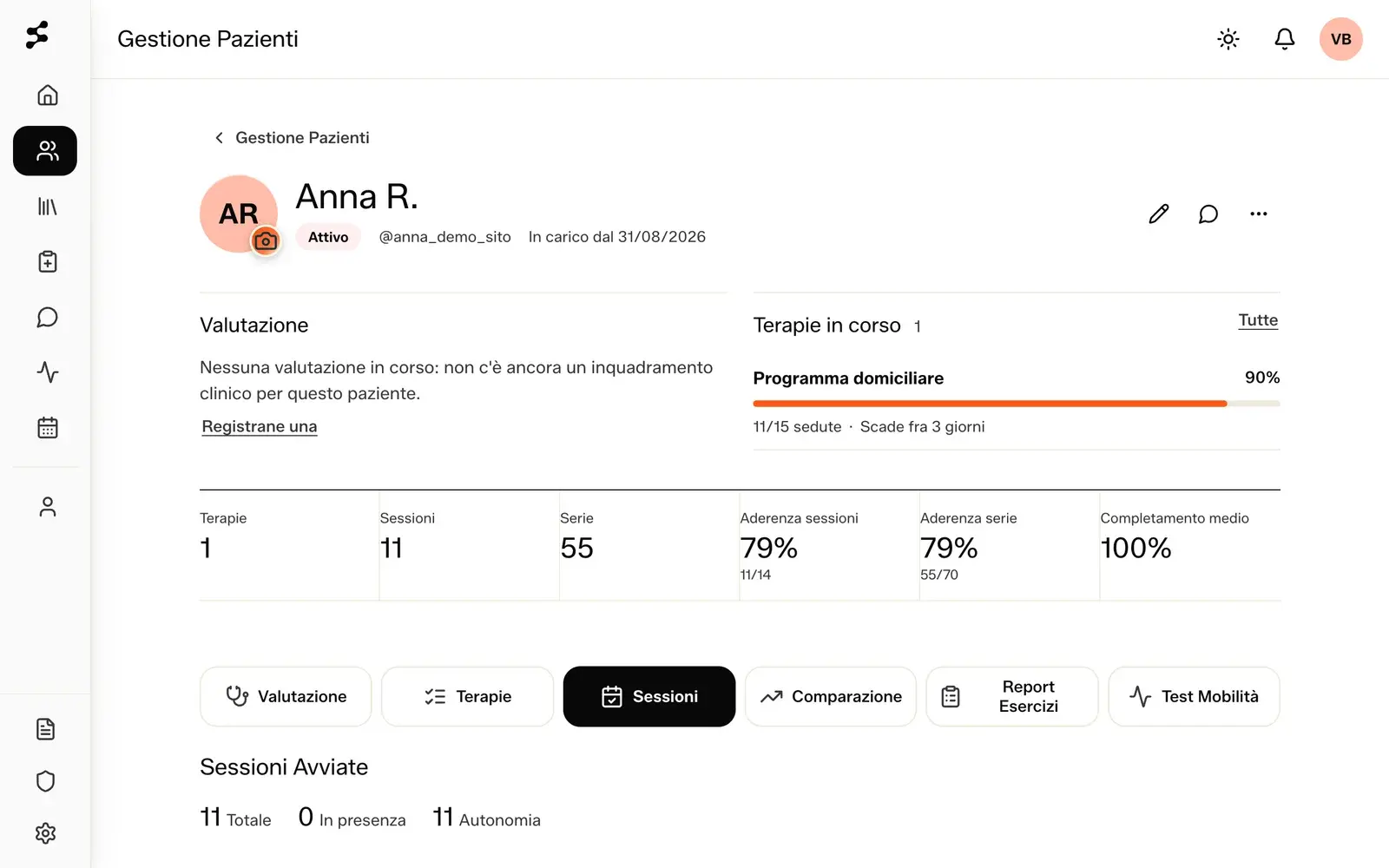
The physiotherapist prescribes the programme and sets its parameters from the dashboard. The patient does the exercises at home in front of their own device's camera, guided by the app's voice, and the physiotherapist reviews the session report and the movement replay. Built-in chat and video calls cover the synchronous part of the pathway.
The analysis runs on the patient's phone. We receive movement data, not images.
Telerehabilitation questions
Are telerehabilitation and remote rehabilitation the same thing?
Yes. They are two names for the same activity, rehabilitation delivered remotely through digital tools by healthcare professionals, within a rehabilitation plan.
Who can deliver telerehabilitation?
Healthcare professionals, each within their own competences, in the multidisciplinary team that draws up the rehabilitation plan. Prescribing, delivering, supervising, monitoring and changing the services remain healthcare activities.
Which patients can follow it?
Patients of any age with disabilities or disorders, or at risk of developing them. Suitability is decided case by case, always in person. What counts is the minimum skill to use the technology, also with a caregiver's help, and adherence to treatment.
What is the difference between synchronous and asynchronous telerehabilitation?
In synchronous telerehabilitation the clinician and the patient are connected at the same time, for example on a video call. In asynchronous telerehabilitation the patient does the exercises on their own and the clinician reviews the data later. The Agreement also allows a mixed mode.
Is telerehabilitation covered by the Italian National Health Service?
It can be, when delivered by a facility accredited for those activities. The Agreement sets a tariff equal to the same in-person service; codes and terms depend on the acts through which each Region adopts it.
Is the patient's consent required?
Yes. The patient is told about the remote mode and about how their data is handled. Consent is kept in the clinical record and can be withdrawn at any time.
Is Selfmotion a medical device?
Selfmotion is undergoing MDR certification as a medical device. The manufacturer and device details are on the Regulatory information page.
What does the patient need to use Selfmotion?
Their own phone, placed on a steady surface. The app uses the camera and there are no sensors to wear. The patient gets an invitation from the facility and finds the programme prescribed by the physiotherapist in the app.
Want to offer telerehabilitation at your facility?
A 20-minute demo, with your real cases.